Hai Jawani Toh Ishq Hona Hai Review
Plot
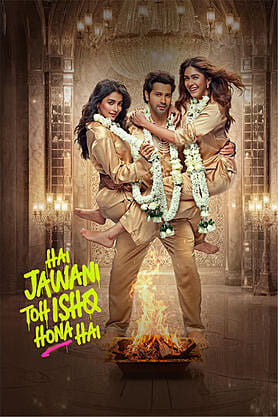
From the very first frame, Hai Jawani Toh Ishq Hona Hai establishes itself not as a forward-thinking cinematic venture, but rather an elaborate time machine built to transport the viewer back to the gilded excesses of Bollywood's 1990s golden age. The narrative premise is fundamentally classic: it’s a whirlwind, highly pressurized romantic comedy centered around one perpetually panicked protagonist and his unexpected predicament involving two simultaneous pregnancies. At its heart, we have Jaswinder “Jass” Ahuja, a wedding photographer caught in the crosscurrents of modern life—a man desperately trying to maintain emotional equilibrium while managing secrets that could potentially implode his personal existence at any given moment. His initial entanglement is with Bani, an ambitious corporate executive who harbors no desire for motherhood and whose primary focus remains locked firmly on her career trajectory. Their strained relationship forms a classic setup: the conflict of professional ambition versus biological inevitability.
The plot thickens considerably when Jass relocates internationally to London, where fate—or perhaps destiny's most oblivious scriptwriter—introduces him to Preet, a captivating woman who seems written from a Bollywood dream sequence. Their blossoming connection is complicated by the omnipresent shadow of family expectation and the highly melodramatic interference of Preet’s protective older brother. The sheer delicious absurdity of the plot reaches its apex when two seismic announcements hit Jass almost simultaneously: both his estranged wife, Bani, and his new love interest, Preet, are pregnant. Suddenly, a single man is faced with the monumental logistical and emotional challenge of keeping two vastly different women happy while maintaining the enormous, stressful lie that he is the father to all expected little miracles.
While this core 'double-timer' structure isn't a revelation—it feels more like a meticulously polished revival of tropes explored in everything from Saajan Chale Sasural to various melodramas with a paternity twist—the execution attempts a jarring blend of old school spectacle and modern social commentary. The film smartly tries to incorporate contemporary elements, suggesting that today’s relationships are navigated via Instagram profiles or discussed over therapeutic counseling sessions. However, these modern veneers rarely disguise the structural skeleton underneath. The script dips heavily into exaggerated misunderstandings, farcical domestic conflicts, and highly sentimentalized moments of forced revelation. It constantly reminds us that in this hyper-masculine, comedy-fueled universe, nothing can be taken at its face value; every casual encounter must contain a potential life-altering secret.
The script’s greatest strength, if one dares call it such, lies in its willingness to embrace the sheer lunacy of situation comedy. It leans into predictable fun—the hiding scenes, the hospital gags, the misunderstandings fueled by ill-timed phone calls or cryptic messages—all serving up a digestible dose of cinematic fluff. You are constantly positioned for laugh-out-loud moments delivered with maximum physical commitment from Varun Dhawan, who must juggle being heartbroken fiancé, international lover, and desperate secret keeper all at once. Despite moments where the plot demands suspension of disbelief so elastic it threatens to tear reality apart (e.g., why a wedding photographer owns an impossibly large apartment in such an expensive neighborhood), the journey is relentlessly entertaining from a structural standpoint. It’s less about narrative originality and more about genre mastery—a grand, slightly cheesy, highly choreographed celebration of what happens when Bollywood gives its rom-com gears a healthy dose of nostalgia oil.
Acting
The power of Hai Jawani Toh Ishq Hona Hai hinges almost entirely on the charismatic exhaustion radiating from Varun Dhawan. He tackles an incredibly demanding role—a man who must simultaneously embody vulnerable romanticism, panicked farceur, and the accidental master of lies. To pull off this kind of multi-layered performance requires genuine comic timing coupled with a palpable undercurrent of desperate charm, and Dhawan delivers that commitment in spades. For much of the movie, he commits to the sheer magnitude of his panic; you genuinely believe he is going to combust from the pressure of keeping up multiple deceitful fronts. His energy levels are commendable throughout, managing even fatigue-inducing sequences with a bright, slightly manic enthusiasm that carries the weight of the material.
Supporting him, and forming the primary axis of conflict, are Mrunal Thakur as Bani and Pooja Hegde as Preet. It is important to note that both women are written within the highly stylized confines of David Dhawan’s star vehicle: they must be gorgeous, capable of generating significant conflict through minimal emotional vulnerability, and ultimately revolve around the central 'accidental' romance plot. Thakur’s portrayal of Bani captures a frustratingly modern sensibility—the woman who has achieved professional success and views motherhood not as an inevitability but as a complex negotiation with her personal career goals. This layer adds necessary depth to what otherwise would be pure farce, giving her initial resistance genuine weight. Meanwhile, Hegde portrays Preet with the breezy carelessness typical of a romantic comedy heroine destined for drama; she is beautiful, seemingly free-spirited, and capable of making impulsive decisions that drive the plot forward. Their chemistry, while often obscured by the comedic shenanigans of the male leads, manages to maintain a convincing tension, suggesting authentic passion beneath the glamorous surface.
The supporting cast proves equally vital in navigating the genre's required over-the-top energy. Jimmy Shergill, portraying Preet’s older brother, provides the necessary anchor of protective vigilance and mock menace that is essential to the romantic comedy playbook. His character effectively embodies the ‘gatekeeper’ trope—a figure whose initial suspicion must be gradually dissolved by sheer force of overwhelming emotional events. Similarly, the cameos and supporting players (like Chunky Pandey in his professional role) are deployed with enough flair to lift individual scenes out of pure sludge. Rajesh Kumar successfully steps into a traditionally reliable 'suspicious accomplice' slot, giving necessary texture to the network of characters meant to complicate Jass’s life.
However, the acting ensemble struggles when the material dips back into genuinely recycled humor. Despite the committed performances, there are moments—especially in the hospital sequences or comedy beats involving old school references—where the sheer predictability undermines the actors’ efforts. Sometimes, the jokes feel so deeply rooted in nostalgic tropes that even the star’s phenomenal energy can't elevate a dialogue that feels fundamentally dated. Ultimately, while Dhawan elevates his cast and crew by giving them roles to populate an absurdly chaotic world, the emotional arcs of the female leads often remain frustratingly thin, leaving their characters feeling more like plot mechanisms than fully realized individuals capable of guiding the comedic chaos.
Cinematography
From a cinematic standpoint, Hai Jawani Toh Ishq Hona Hai presents a visually striking feast that is meticulously curated to evoke a sense of hyper-polished, highly saturated escapism. The filming employs techniques that are intrinsically linked to the genre: everything must look vibrant, glossy, and perpetually "on vacation." When we see Jass jetting off to London, the cinematography fully commits to establishing an aesthetic sense of wealth and cosmopolitan aspiration. The visuals attempt hard to make this domestic farce feel genuinely cinematic, utilizing expansive shots of opulent homes, from the lavish settings in London—which are crucial for building the sense of international melodrama—to the grand, if slightly exaggerated, interiors required for any mega-Bollywood confrontation scene. This visual magnitude immediately raises the stakes and grounds the emotional turbulence in a luxurious, almost aspirational setting.
The film relies heavily on varied color palettes to delineate different emotional states or plot points. The initial scenes concerning Jass and Bani, dealing with their marital crisis, often utilize warmer, slightly muted tones—the rich browns and dusty golds of a strained home life—reflecting the stagnant state of their relationship. In stark contrast, when Preet enters the picture in London, the cinematography brightens considerably. We see crisp blues, vibrant daylight streaming through large windows, and locations that feel effortlessly 'Instagrammable,' even if they are exaggerated for dramatic effect. This color shift visually signals to the viewer: here is a new emotional chapter—a potentially happier, more exciting one—providing clear visual markers that guide our understanding of the evolving romantic triangle.
What makes the cinematography particularly noteworthy is its skillful use of comedic exaggeration through visuals. During high-action comedy sequences—such as those involving Jass desperately attempting to hide Bani from Preet—the camerawork becomes frenetic, almost manic in its energy. The use of quick zooms, wide-angle shots emphasizing a room’s overwhelming size, and dynamic character framing heightens the sense of breathless chaos that is central to the plot. These visual techniques don't just record the action; they actively contribute to the comedic tone, keeping the audience engaged through sheer visual momentum.
However, occasionally, the visual spectacle feels slightly overdone or lacks genuine subtlety. Some set pieces utilize an excessively heightened reality, where every background element seems designed to scream "rich life!" even when the characters are discussing something mundane like a failed career conversation. While breathtaking in its commitment to maintaining a 'perfect' visual façade, sometimes the sheer glossiness can border on artifice, making the world feel more like a stylized backdrop for slapstick comedy rather than a lived-in environment. Nonetheless, overall, the cinematography successfully navigates the tricky balance required of this genre: providing enough aspirational beauty to make the grand drama believable while simultaneously adopting an exaggerated lens that supports its inherent absurdity. It is visually rich tapestry designed for maximum escapism, ensuring that even when the jokes fail, the visual presentation distracts us with dazzling style.
Direction
Directing a film of this scale—a meta-textual celebration and sometimes desperate rehash of David Dhawan’s own comedic legacy—is nothing short of monumental. The director must manage conflicting priorities: appearing modern and current while simultaneously referencing decade-old cinematic beats, punchlines, and physical comedy styles. What the resulting product achieves is a thrilling but ultimately uneven exercise in homage. At its best, the direction has tremendous emotional warmth and a clear sense of theatrical flair, capitalizing on the inherent fun that comes from watching massive stars commit fully to the ridiculousness of their predicament. The pacing alternates masterfully between rapid-fire, gag-filled set pieces and moments of surprisingly tender, if cliché, dramatic reflection.
The core directorial genius at play is Dhawan’s ability to manage tone shifts. He orchestrates transitions from tearful emotional counseling sessions (the pseudo-serious drama) directly into outright slapstick sequences—all under the umbrella of a love triangle complicated by reproductive biological processes. This whiplash effect, while sometimes jarring and structurally questionable, characterizes the film's unique comedic rhythm. The director understands that the audience for this type of movie wants to laugh loudly and frequently, demanding rapid cuts and punchlines delivered in perfect synchronization with Varun Dhawan’s energy.
What is most fascinating about the direction is its embrace of meta-narrative. By explicitly referencing moments from past movies (like the CPR scene echoing Shaadi No 1 or the structural parallels to *Friends*), the director transforms the film itself into a running conversation with the audience, acknowledging Bollywood's history every few minutes. This self-awareness, far from being just gimmickry, provides both comedic relief and structure. It tells the audience: "We know this is highly formulaic, but trust us, we’re going to make it fun anyway."
However, this directorial choice also harbors its major flaw: a dependence on pattern recognition. When the film leans too heavily into its nostalgic DNA, the jokes lose their edge. The direction sometimes fails to give enough breathing room for genuine emotional beats to land organically; emotions are often circumvented by an ensuing gag or song sequence. This is especially noticeable in the handling of scientific or social topics (like contraception or reproductive rights), which are treated with a disproportionate amount of slapstick, robbing them of any real weight or consequence. The direction assumes that universal comedy can be achieved purely through physical exaggeration and rhyming punchlines, neglecting more subtle forms of humor or genuine character development.
In its final directorial bow, the film is more a brilliantly executed collection of sketches than a cohesive narrative journey. The director functions less as an artisan building a single structure and more as a masterful juggler operating with dozens of dazzling, frequently hand-off stunts. For pure entertainment value, for sheer, joyous cinematic spectacle, the direction succeeds spectacularly. It's overblown, predictable, yet undeniably charismatic—a perfect blockbuster confection designed solely to provide a temporary sugar rush of loud laughter.
Conclusion
Hai Jawani Toh Ishq Hona Hai stands indisputably as a monument to peak Bollywood comedy tradition mixed with modern anxieties. It is not a film that seeks to change the way we think about romance, marriage, or even basic human logic; rather, it operates as a glorious, sprawling carnival ride dedicated to making us laugh until our abs hurt. The film’s core strength lies in its unapologetic, unbridled embrace of melodrama and over-the-top farce. It fully commits to the established David Dhawan universe—a space where questionable life choices are rewarded with magnificent, ridiculous laughter.
The cinematic adventure is loud, saturated, relentlessly energetic, and structurally cyclical. Is it critically groundbreaking? Absolutely not. One might question why a character in this high-flying international rom-com isn't simply able to access basic logic when faced with paternity choices involving two expectant mothers! If you are looking for nuanced social commentary or cinematic realism, keep scrolling; your search is over.
But if what you crave is an immersive gut-punch of sugar-coated nostalgia—a popcorn movie experience that rewards physical effort, infectious energy, and a willingness to suspend all critical judgment right from the opening credits—then this film earns its stripes. Varun Dhawan’s phenomenal commitment fuels every ridiculous subplot, while the cinematography ensures that even when the jokes feel painfully recycled or desperately derivative, the visuals are so gorgeously saturated and grandly orchestrated that they keep your eye fixed on the spectacle. It's a visual treat, a rhythmic punchline fest, and an absolute blast of sensory overload.
Ultimately, Hai Jawani Toh Ishq Hona Hai is less a story about modern love and more a cinematic tribute to the joyous excesses of Hindi cinema history. It asks us to surrender our sophisticated critical guard, to accept that illogical messes are sometimes simply mandatory for maximum comedic effect, and to fall back in love with the glorious messiness of Bollywood high-octane fun. Go see it if you need a collective chuckle, because even if some parts feel laughably dated, the sheer collective effort to be entertaining is undeniably infectious. It’s a chaotic, vibrant, utterly enjoyable cinematic fever dream that solidifies its spot as mandatory viewing for anyone who ever needed a good dose of 'sugar-coated nostalgia.' Highly recommended for a supremely fun, zero-stakes evening out.
Share this review